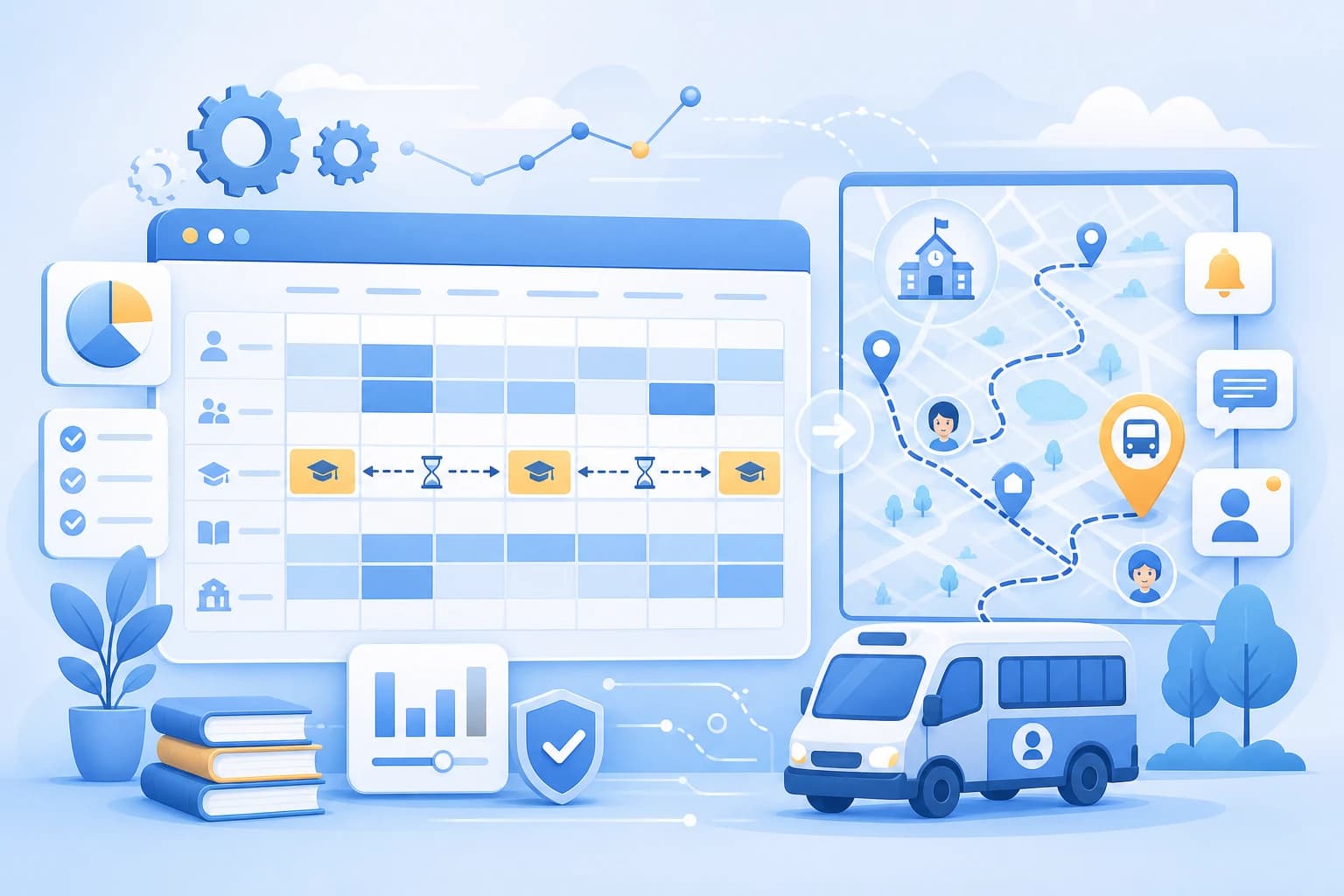
School scheduling is one of the most complex planning challenges in education. It often requires weeks—sometimes months—of preparation, yet a single change can disrupt the entire timetable.
When a schedule works, it's invisible; classes run smoothly and rhythms are clear. But when a teacher is absent or a room conflict arises, the timetable immediately becomes the center of attention. The issue isn't a lack of effort—it's the sheer complexity of constraints and the unpredictability of reality. In contexts like Morocco's education system, these challenges are amplified by structural inequalities and resource constraints.
The Limits of Traditional Timetabling
Traditional scheduling relies heavily on manual processes and rigid spreadsheets that struggle to adapt once published. Planners must constantly juggle:
- Teacher availability and workload limits.
- Classroom and resource constraints.
- Subject distribution across the week.
- Pedagogical rules and institutional policies.
These hard and soft constraints interact in ways that make manual optimization nearly impossible.
Even a minor adjustment can trigger a chain reaction, forcing planners to revisit dozens of decisions manually. Because of this "cost" in time and effort, schools often avoid necessary flexibility.
Flexibility Without Insight Creates Risk
While schools need flexibility, having it without structure creates imbalance. Uninformed last-minute changes may:
- Overload specific teachers.
- Create gaps or conflicts in student schedules.
- Reduce the overall quality of learning time.
The real challenge is learning how to be flexible intelligently.
A New Paradigm: The Living System
Planifica introduces a shift in thinking: instead of a fixed result, the timetable is a living system. Schedules are generated based on real constraints and evolve as conditions change.
With Planifica, schools can:
- Automatically generate timetables aligned with all constraints.
- Configure rules and priorities according to specific policies.
- Simulate scenarios before finalizing decisions.
- Adjust schedules while maintaining balance and feasibility.
From Manual Adjustments to Data-Driven Decisions
Imagine a teacher becomes unavailable for a specific slot for several weeks. In a traditional setup, this involves manual edits and compromises.
With Planifica, the constraint is updated once. The optimizer recalculates feasible schedules, detects conflicts automatically, and generates a balanced alternative — powered by linear optimization techniques that evaluate thousands of possibilities in minutes. Decisions shift from being based on urgency to being based on measurable impact.
Conclusion: Optimization in Service of Education
Optimization is about creating sustainable schedules that respect teachers, students, and institutional constraints. By combining AI-driven optimization with scenario simulation, Planifica empowers schools to plan with confidence and adjust with clarity.
School scheduling is no longer about avoiding change. It's about being ready for it.