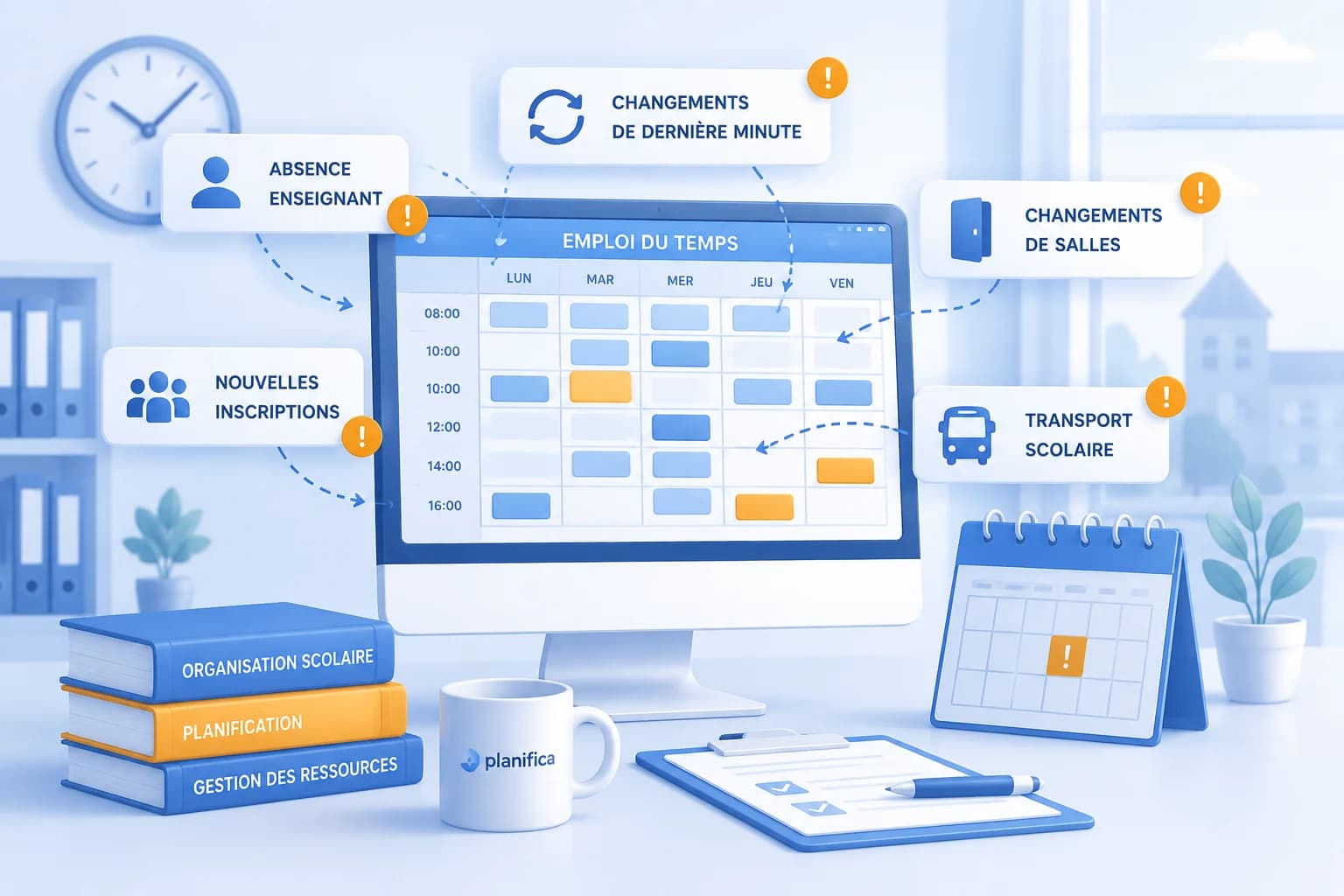
If you've ever been involved in creating a school timetable, you know the frustration. What seems like a straightforward task—assigning classes to time slots—quickly becomes an overwhelming puzzle with hundreds of competing demands.
This guide explains why timetabling is genuinely difficult and how modern approaches can help create better schedules for everyone.
The Timetabling Problem in a Nutshell
Creating a timetable means organizing lessons into time slots and rooms while respecting certain rules. Some rules are absolute, while others are preferences we'd like to honor when possible.
Hard Constraints: The Non-Negotiables
These are rules that cannot be broken under any circumstances:
- A teacher cannot be in two places at once. If Mr. Garcia teaches Grade 10 Math at 9 AM, he cannot also teach Grade 8 Science at the same time.
- A classroom can only hold one class. The science lab cannot host two different experiments simultaneously.
- Required hours must be met. If the curriculum requires 5 hours of French per week, the schedule must include exactly that.
Soft Constraints: The Preferences
These are requests we try to accommodate, but sometimes cannot:
- A teacher prefers Wednesday afternoons off for professional development
- The PE department wants outdoor classes in the morning before it gets too hot
- A part-time teacher is only available on certain days
The challenge is that while hard constraints must always be satisfied, soft constraints often conflict with each other. Honoring one teacher's preference might make it impossible to honor another's.
Why Traditional Approaches Struggle
Most scheduling software—and most humans doing it manually—tackle timetabling the same way: place lessons one by one, following strict rules, and backtrack when problems arise.
The Step-by-Step Trap
This approach works like solving a puzzle piece by piece. You place Math for Grade 10 on Monday at 9 AM. Then you place Science for Grade 9. Then French for Grade 11. Each placement follows the rules.
But here's the problem: the decisions you make early affect what's possible later. A choice that seems fine in isolation might paint you into a corner.
The 95% Problem
Here's something frustrating that many administrators recognize: traditional software can fill 95% of the timetable very quickly. The first lessons slot in easily. But those last few lessons? They become nearly impossible to place.
Why? Because early decisions—made without considering the full picture—have eliminated the flexibility needed for those final placements. Many programs simply give up at this point, leaving the hardest work to humans.
Soft Constraints Get Ignored
Traditional systems also struggle with preferences. When placing lessons one by one, it's hard to know whether accommodating a soft constraint now will cause problems later. So most systems focus only on hard constraints and ignore preferences until the end—if they consider them at all.
Why Staff Needs Matter
From a student perspective, timetable needs are fairly consistent: minimal gaps between classes, a balanced distribution of subjects throughout the week, and not too many early morning or late afternoon sessions.
But staff needs are more varied and equally important:
School Leaders and Administrators
Principals and department heads often have administrative duties that require them to be available at specific times. They may only be able to teach during certain windows.
Teacher Preferences
Teachers have legitimate preferences that affect their wellbeing and effectiveness:
- Compact schedules: Teachers prefer not to have a single class at 8 AM, then nothing until 2 PM. Waiting around wastes their time and energy.
- Specific time slots: Some teachers have childcare responsibilities, ongoing education, or health considerations that make certain times difficult.
- Half-days off: A teacher might request Friday afternoons off for family reasons or to pursue professional development.
Why This Matters
Ignoring staff needs doesn't just affect morale—it affects retention. In a competitive environment for qualified teachers, a scheduling system that consistently disregards reasonable preferences contributes to burnout and turnover.
A good timetable balances everyone's needs, not just the students'. This challenge is especially acute in regions facing structural staffing shortages and territorial inequalities, where scheduling flexibility can make the difference between retaining teachers and losing them.
A Better Approach to Scheduling
Modern optimization takes a fundamentally different approach, treating the schedule as a living system rather than a static artifact. Instead of placing lessons one by one and hoping everything works out, it considers the entire problem simultaneously.
Fitness-Based Optimization
Rather than treating constraints as pass/fail gates, advanced systems evaluate schedules based on overall "fitness"—how well a complete schedule satisfies all requirements, both hard and soft.
This means the system can explore many possible arrangements and gradually improve toward one that works for everyone. It's not influenced by the order in which constraints are checked.
Exploring the Full Solution Space
Instead of making early decisions that limit later options, modern optimization explores the complete range of possibilities. This is how it avoids the "95% problem"—by considering the full picture from the start.
Balancing Competing Priorities
When soft constraints conflict—and they often do—the system can make intelligent trade-offs based on priorities you define. Perhaps accommodating part-time teachers is more important than giving everyone their preferred lunch slot. The system can balance these competing needs systematically rather than arbitrarily.
What This Means for Your School
Effective timetabling goes beyond simply creating a feasible schedule. It requires balancing student needs, staff preferences, and institutional priorities while making the best possible use of available resources.
The result is more than administrative convenience:
- Happier staff who feel their needs are considered
- Better resource utilization with fewer empty classrooms and idle periods
- Reduced conflicts and last-minute schedule changes
- More time for administrators to focus on educational priorities rather than scheduling headaches
Learn More
Curious about the technical details of how optimization actually works? Read our companion article: How Timetable Optimization Works: A Technical Guide.
For more insights on scheduling:
- Linear Optimization vs Genetic Algorithms - Why the algorithm matters
- Optimizing Class Schedules: A Comprehensive Guide - Traditional, block, and hybrid approaches
- Schedule Optimization FAQ - Common questions answered
Ready to see how Planifica can transform your school's scheduling process? Request a demo and experience the difference that intelligent optimization makes.